
Updated October 2026
What HFT Trading is
HFT Trading, short for high-frequency trading, is automated trading that reacts to market data and sends orders faster than a person can click. The computer does not “predict the news.” It compares prices, order-book changes, and venue delays, then acts while that difference still exists.
In equity markets, HFT firms are a large share of daily volume. In FX, CFDs, and futures the same idea appears in a simpler form: a faster feed updates before a slower broker screen, and a strategy tries to trade that gap. The name changes. The constraint does not. If your order arrives after the price has already moved, the opportunity is gone.

HFT Trading depends on four things working together: a raw price feed, a server close to the matching engine, code that decides without waiting, and an order path that does not add its own delay. Remove any one of them and the strategy becomes a normal algorithm with a normal result.
How HFT Trading works
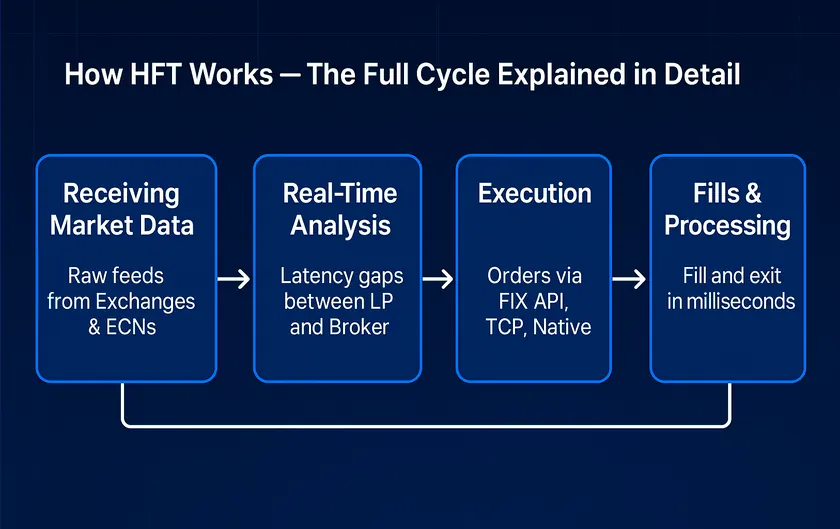
Every HFT system runs the same loop, thousands of times a second: receive, compare, decide, send, and measure. The loop is short on purpose. Extra logging, extra risk checks, and extra network hops are costs, not features.
1. Receive the book
The feed is tick by tick. Institutional protocols such as ITCH describe every add, cancel, and trade. A retail quote is a filtered summary of that activity, often after several hops.
2. Compare venues
The strategy looks at the fastest price, the slower displayed price, the spread, and the last few milliseconds of movement. A gap is a delay, not a forecast.
3. Send the order
If the gap is large enough to cover spread, fees, and expected slippage, the system sends an order through FIX, a native gateway, or another direct API. Then it records the fill so the next decision is based on what actually happened.
Where the fastest quotes come from
Prices do not start on a trading platform. They start with liquidity providers and exchanges that stream bids and offers into a matching engine. ECNs and dark-pool-style venues publish that stream to subscribers who pay for direct access. Brokers sit further down the chain: they aggregate providers, apply risk limits, and republish a price their clients can trade.
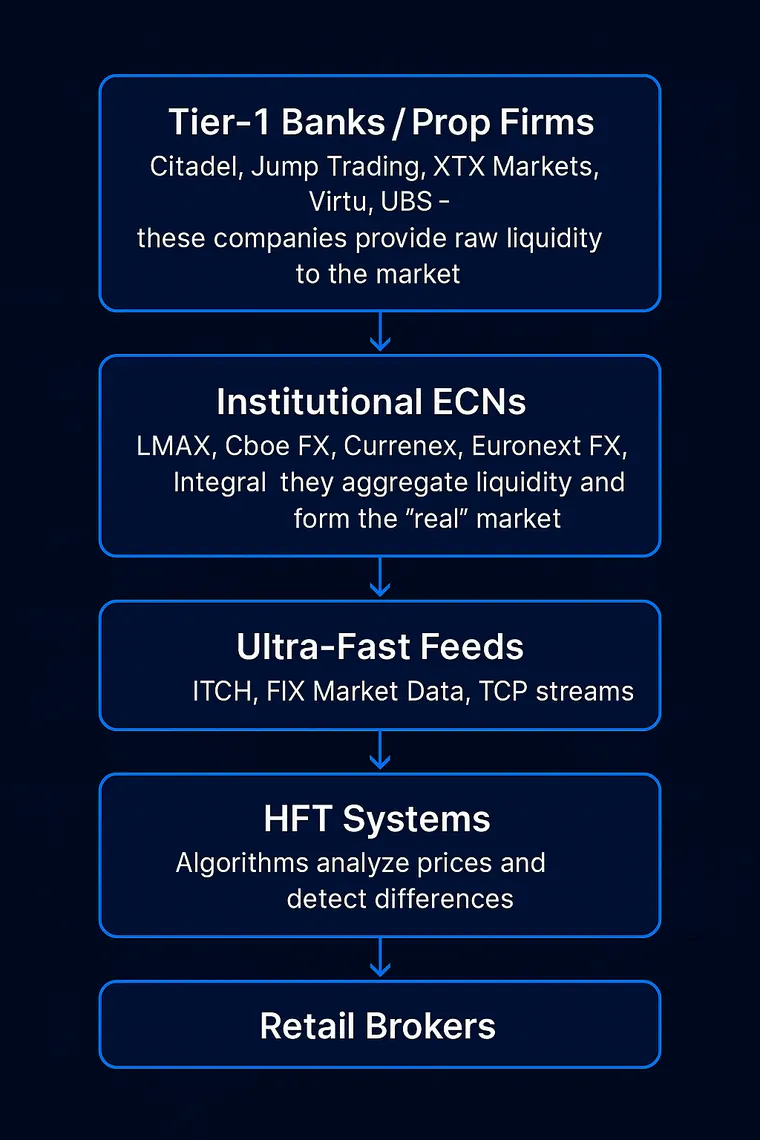
That extra path is why a chart can look “late.” Aggregation, smoothing, and internal checks make the feed easier to use and harder to game, and they also add time. HFT Trading lives in that time. A price of 1.10040 on a top-tier feed and 1.10020 still showing at a broker is not a prediction that the market will rise. It is evidence that one screen has not caught up.
The infrastructure behind HFT Trading
Distance is part of the strategy. Light in fiber is fast, and it is still not instant. Firms rent racks in the same data centers as the exchanges — LD4 in London, NY4 in New York, TY3 in Tokyo, SG1 in Singapore — because a server in the next cage beats a server in another city.
- Colocation puts the strategy next to the matching engine.
- Microwave and millimeter-wave links beat fiber on some city-to-city routes because the path is straighter.
- FIX and native exchange protocols carry orders without a desktop platform in the middle.
- A home PC or a generic VPS is usually 100 milliseconds or more away from that race.
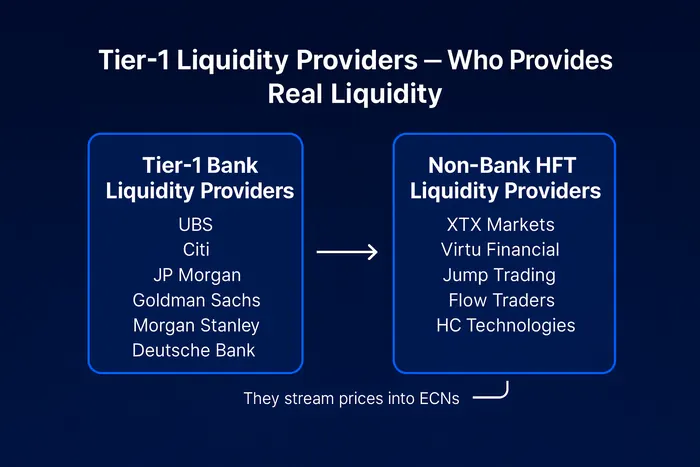
Hardware follows the same rule. Teams strip operating-system noise, pin threads to CPU cores, and sometimes bypass the kernel network stack. The goal is a stable tail latency, not a pretty average. One slow order in a hundred can erase the edge of the other ninety-nine.
Strategies people mean by HFT Trading
HFT is a speed class, not a single idea. The strategies that fit inside it share a short holding time and a dependence on microstructure.
- Market making. Quote both sides, earn the spread, and pull quotes when the book turns against you.
- Latency arbitrage. Trade a slower venue against a faster feed before the slower price updates.
- Statistical microstructure. React to order-book imbalance, queue position, or short-lived cross-venue gaps.
- Index and ETF rebalancing flow. Hedge related instruments when one leg moves first.
Retail software that talks about HFT Trading is usually closest to the second item: compare a fast professional feed with a broker price and send an order if the gap survives costs. That can work only while the broker accepts the flow and the measured slippage stays smaller than the gap. It is not the same business as a registered market maker inside NY4.
Software built for this race
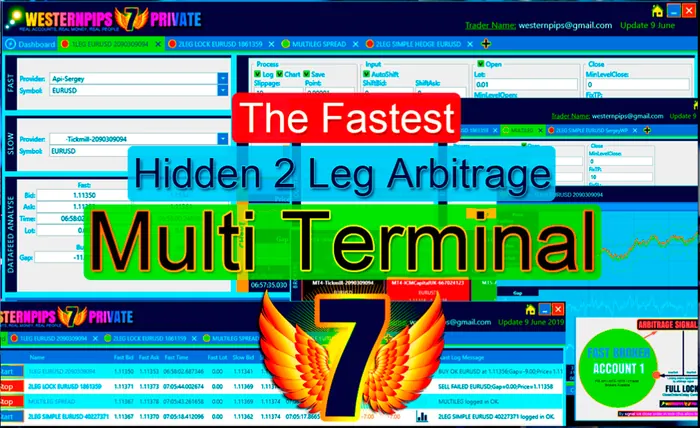
Westernpips has built latency-sensitive trading software since 2007. Private 7 connects to fast market-data sources and sends orders through low-level paths, including FIX, so a strategy can act on a price gap instead of waiting for a manual click.
HFT Trading on video
The films below show the engineering side of the business: the people who treat the market as a network problem, and the practical checks — installation, gaps, and slippage — that decide whether a fast signal is tradable.

The Wall Street Code
A documentary on the programmers who turned market access into a speed contest, and on the infrastructure that grew up around them.

Setup, menus, and strategies
How a latency-arbitrage terminal is installed, activated, and pointed at a strategy before it is allowed to trade.

Gap and slippage
The gap is the difference between a fast feed and a slower price. Slippage is what remains after the broker fills the order. Both numbers have to be measured.

Testing on recorded ticks
A strategy that only looks good on a candle chart is not an HFT strategy. Tick replay is how you see fills, delays, and failed entries.
What HFT Trading does not guarantee
Speed is an advantage only while the other side is slower and the venue still fills you. Brokers change feeds, widen spreads, reject automated flow, or last-look a quote. A backtest on clean ticks can hide all of that. Live trading can lose money quickly because position size and order rate are both high.
Foreign-exchange and CFD trading can result in the loss of your capital. Leverage increases that loss. Nothing on this page is a solicitation to trade, and past descriptions of market structure are not a promise of profit.
People also ask about HFT Trading
These are the questions Google shows next to the query HFT Trading, with a direct answer for each one.
What is HFT trading?
HFT trading meaning: high-frequency trading is automated trading that reads prices and sends orders in microseconds or milliseconds. The computer is not forecasting the news. It tries to be first to a price that is already true on a faster feed. That is the plain meaning of HFT Trading.
Is HFT trading illegal?
No. HFT Trading is legal in the United States, the European Union, the United Kingdom, India, and other major markets when the firm follows exchange rules and market-abuse law. What is illegal is manipulation: spoofing, layering, and placing orders only to mislead other traders. Speed by itself is not a crime.
Is HFT trading profitable?
It can be, and it often is not. Firms that own the fastest line and the best queue make small amounts on a huge number of trades. A retail account pays spread, commission, and slippage. If those costs are larger than the price gap, the same strategy loses money. Profit is a measured result after costs, not a property of the word “HFT”.
Which broker allows HFT trading?
No public list stays accurate. A broker allows this style of trading only if its rules permit expert advisors or a FIX/API connection, it does not ban latency strategies, and its servers are close to your trading server. Before you send size, ask the broker in writing whether automated high-frequency orders are accepted, then test fills. A broker that last-looks every quote or widens the spread on fast orders will not work.
How fast is high-frequency trading?
Inside a colocation hall, reaction time is often under a millisecond. A home connection is commonly 150–300 ms slower. That gap is the whole business.
HFT Trading keywords
Related searches people type after HFT Trading. Each phrase below is answered on this page.
- HFT trading bot
- HFT trading meaning
- HFT trading firms in India
- HFT trading firms
- HFT trading software
- HFT trading strategies
- HFT trading bot MT5
- HFT trading course
- HFT trading jobs
HFT trading bot
An HFT trading bot is software that watches a fast price and sends orders without a mouse click. A real bot is only as fast as its feed and its server. A bot on a laptop is an expert advisor with a slow path, not a high-frequency system.
HFT trading meaning
The meaning of HFT Trading is high-frequency trading: short holding times, automated decisions, and a dependence on being early. It is a speed class. Market making, latency arbitrage, and order-book tactics can all sit inside it.
HFT trading firms in India
India has an active HFT market on NSE and BSE. Firms that publicly operate in this space include names such as AlphaGrep, Graviton, Quadeye, iRage, and Estee. They hire engineers in Mumbai, Gurugram, Bengaluru, and Delhi, and they colocate at the exchange. This is not a ranking and not an invitation to copy their strategies.
HFT trading firms
Global HFT trading firms include Citadel Securities, Jump Trading, Hudson River Trading, Virtu, Tower Research, Two Sigma, and DRW. They compete on colocation, private network routes, and custom code. Most do not sell a retail robot.
HFT trading software
HFT trading software connects a market-data feed to an order gateway such as FIX, ITCH, or a broker API. Westernpips Private 7 is one retail-facing example aimed at latency gaps in FX and CFDs. Institutional stacks are usually built in-house and never published.
HFT trading strategies
Common HFT trading strategies are market making, latency arbitrage, cross-venue gaps, and short-lived order-book imbalance. All of them die when the measured slippage is larger than the edge. Test them on recorded ticks before they touch a live account.
HFT trading bot MT5
An MT5 bot can send orders automatically, but MetaTrader is not a colocation matching engine. An “HFT trading bot MT5” only helps if the terminal runs on a server next to the broker and the strategy is a latency gap the broker still fills. The platform itself adds delay. Measure that delay before you raise the lot size.
HFT trading course
A useful HFT trading course teaches market microstructure, latency measurement, order types, and how to read a fill log. It does not sell a guaranteed daily return. The practical path is a programming background, a statistics background, and time on a test server — not a signal group.
HFT trading jobs
HFT trading jobs are mostly engineering: low-latency C++, FPGA and network engineering, quantitative research, and production support. Trading roles exist, but the hiring bar is a degree in computer science, mathematics, or physics, plus proof you can write fast, correct code. Firms recruit from campuses in the US, Europe, and India.